

Many people think of rowing machines as purely cardio equipment for improving fitness and burning calories. But once you start rowing properly, you quickly realise there’s far more going on. Your legs drive the movement, your back and arms generate the pull, and your core works constantly to keep everything stable. With the right resistance and training style, rowing can feel every bit as challenging as a strength workout.
That’s why rowing is used in different ways. Some people use it mainly to improve cardiovascular fitness and endurance, while others use it as a full-body training tool to build lean muscle, strength, and athletic conditioning.
In this guide, you’ll learn how to use a rowing machine effectively for muscle building. We’ll cover the best rowing methods for strength, common mistakes that slow progress, and the workouts that help you become stronger and fitter. If your goal is a leaner, more athletic, and more powerful physique, rowing can be an excellent way to get there.
1. What Muscles Does a Rowing Machine Work?
A rowing machine can absolutely help build muscle, although not quite in the same way as traditional weight training. Every stroke creates resistance that your body has to work against. With proper technique and enough resistance, rowing becomes a demanding full-body workout that engages several major muscle groups at once.
- Legs: Generate most of the power during the drive phase
- Back: Supports the pulling movement and helps maintain posture
- Core: Stabilises the body and transfers power efficiently
- Arms & Shoulders: Finish the stroke and control the movement
The way you train has a major impact on your results. Longer, steady rowing sessions are excellent for improving fitness, endurance, and calorie burn. However, if you increase the resistance, slow the stroke rate slightly, and include interval training, rowing can also help develop strength and lean muscle.
That’s why people often get different results from rowing. Some mainly improve stamina and cardiovascular fitness, while others use it as a full-body conditioning workout to become stronger, leaner, and more athletic.

2. Rowing Machine vs Other Exercises for Muscle Building
So how does rowing compare with running, cycling, or traditional strength training when it comes to building muscle?
The biggest advantage of rowing is that it combines strength training, cardio, and full-body movement in one session. It helps improve functional strength, fitness, and overall conditioning in a very efficient way.
Rowing vs Running
Running is excellent for cardiovascular endurance, but it mainly targets the lower body and places more impact on the knees and ankles. Rowing provides a low-impact alternative that is much gentler on the joints while still allowing for intense training.
Because of this, many people find they can train more consistently, recover more comfortably, and use higher resistance without the same level of joint strain.
Rowing vs Cycling
Cycling mainly focuses on the legs, with less involvement from the upper body. Rowing, on the other hand, engages around 85% of the body’s muscles with every stroke, including the legs, back, core, shoulders, and arms.
This makes rowing a more balanced option for overall muscle development and full-body conditioning.
Rowing vs Traditional Strength Training
Traditional weight training is still the best option for maximum muscle growth and heavy hypertrophy. However, rowing is ideal for people who want lean muscle, athletic conditioning, and functional strength without relying on multiple gym machines or placing excessive stress on the joints.
For many people, rowing is an efficient way to train both strength and endurance at the same time. Rather than isolating muscles individually, it teaches the body to work together as one system — which is one reason rowing is so popular with athletes, coaches, and people who prefer practical, time-efficient workouts.
If your goal is a leaner, fitter, and more athletic physique without spending hours moving between different machines, rowing is one of the most effective training options available.
3. Best Rowing Workouts for Muscle Building
The most effective rowing workouts for muscle building combine power intervals, controlled pacing, and higher resistance to challenge the entire body. By mixing strength-focused rowing with endurance work, you can build lean muscle, improve fitness, and develop a stronger, more athletic physique.
These workouts train the arms, back, core, and legs together, improving both muscular endurance and overall performance.
Power Strokes for Upper-Body Strength
Use a slower stroke rate, higher resistance, and maximum power through each pull. This style of rowing places more emphasis on the upper body, particularly the back, shoulders, arms, and core.
Training at a controlled pace allows you to focus on strong, technically sound strokes while maintaining good form. Aim for roughly 20–24 strokes per minute with consistent power output.
This type of workout helps improve pulling strength, upper-body endurance, and posture, while placing less stress on the joints than many traditional gym exercises.
Low-Stroke, High-Resistance Sessions
These sessions focus more on strength and control than speed. With heavier resistance and a lower stroke rate, each movement becomes more demanding for the legs, core, and back.
The slower pace gives you more time to generate force correctly and maintain proper technique throughout the workout. Many people use this style of rowing alongside strength training to improve overall power and conditioning.
It’s an effective way to build functional strength while still benefiting from the smooth, low-impact movement rowing is known for.
Interval Training for Muscular Endurance
Intervals combine short bursts of high effort with brief recovery periods. This style of training is highly effective for improving muscular endurance, cardiovascular fitness, and power output.
A simple structure is:
- 30 seconds hard rowing
- 30 seconds recovery
- Repeat for 10–15 rounds
These sessions train the body to maintain performance under fatigue while helping improve stamina and conditioning. They’re especially useful for people who want efficient workouts that build both strength and endurance at the same time.

If your goal is muscle development rather than light cardio, the rowing machine you choose also matters. Many entry-level magnetic rowers offer fairly limited resistance, which can restrict long-term strength progression.
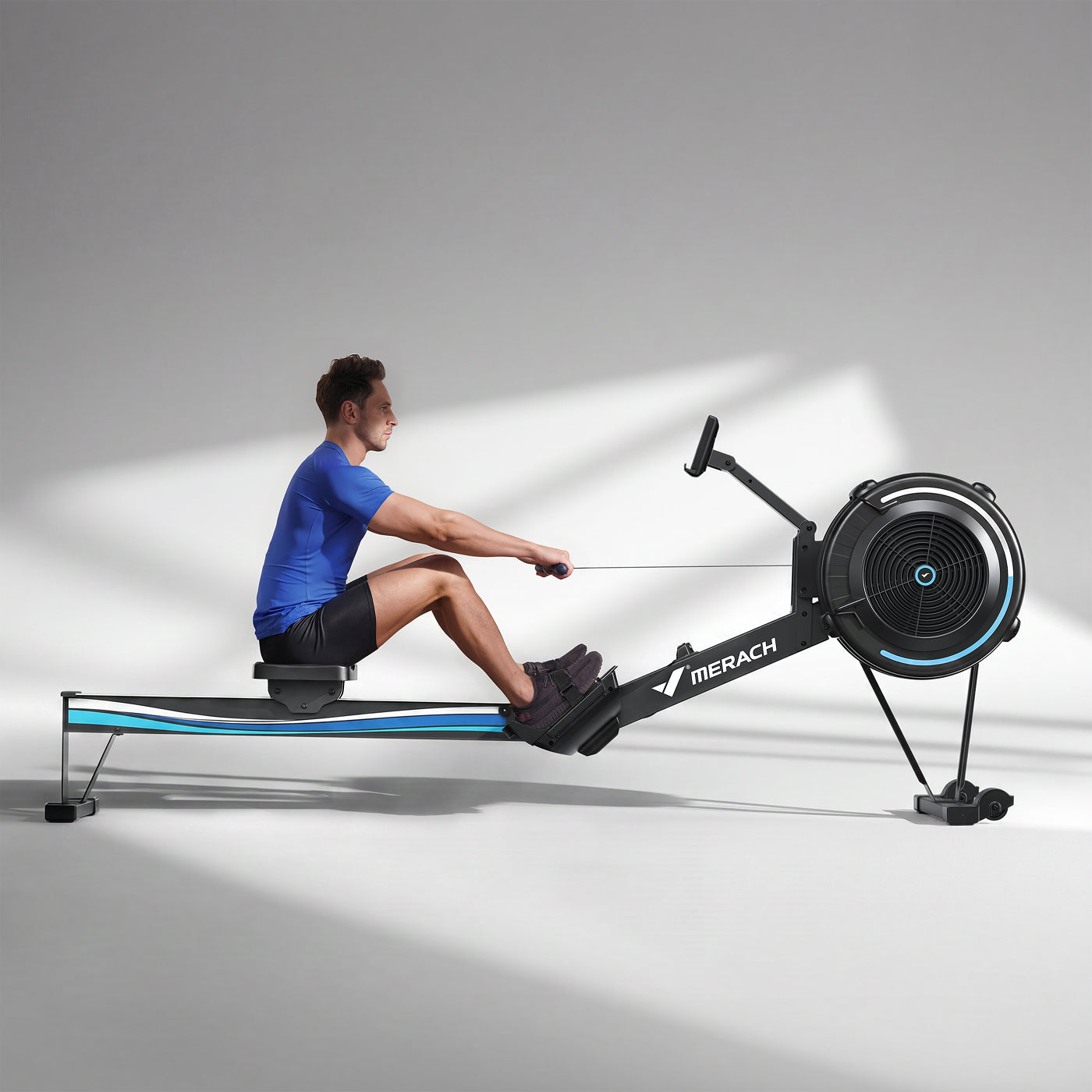
By comparison, the Merach NovaRow R50 Air Resistance Rower is designed to provide a more demanding and scalable training experience for home use.
Its air resistance system increases resistance naturally the harder you pull, creating a more realistic rowing feel and allowing for progressive overload — which is important for building strength and muscle over time.
With 10 adjustable damper settings and resistance levels of up to 50 kg, it can suit both beginners and more experienced users. The longer steel rail and 159 kg weight capacity also improve stability, making it suitable for a wide range of body types and training intensities.
Overall, it’s better suited to people looking for a more serious full-body workout at home, combining conditioning with meaningful strength work rather than purely light endurance training.
4. Conclusion
A rowing machine is one of the most effective low-impact ways to build strength, improve fitness, and develop a more athletic physique. It combines cardio and resistance training in a single workout, helping you build lean muscle, increase endurance, and improve overall conditioning — all while being gentler on the joints than many traditional forms of exercise.
Unlike workouts that isolate individual muscle groups, rowing trains the body as a complete system. Every stroke engages the legs, core, back, shoulders, and arms, making it an efficient full-body workout for both strength and fitness.
Whether your goal is to get fitter, stronger, or leaner, rowing offers a practical and time-efficient way to train at home. With the right resistance, technique, and workout structure, it can deliver noticeable improvements in power, stamina, and overall body composition over time.